
27 August 2026 · 16 min read
Villa Concierge in Marbella: What Premium Service Actually Includes
A villa concierge is the person or service that turns a private holiday home into a coordinated stay: matching the property to the guests, arranging practical details, anticipating friction, and remaining available for agreed support before and during the visit. For a family arriving in Marbella, a couple planning a special dinner in Estepona, or a travel advisor handling a multi-generational group, the value is not simply “more recommendations”. It is the disciplined connection between the villa, the itinerary, local suppliers, and the people staying there.
Table of Contents
- What a Villa Concierge actually does
- Why concierge support changes a luxury villa holiday
- How the concierge process works from enquiry to departure
- Where Villa Concierge service breaks down
- How practitioners apply concierge support in Marbella and the Costa del Sol
- The specific recommendation for a successful villa stay
What a Villa Concierge actually does
The phrase is often used loosely. Sometimes it means a welcome hamper and a list of restaurants. In a properly managed luxury rental, it describes a service layer around the villa: a named contact understands the booking, knows the home’s operating limits, coordinates approved suppliers, and gives guests a clear route to help.
That distinction matters because a private villa is not a hotel. There may be no reception desk, no daily housekeeping unless requested, and no on-site engineer waiting behind a service corridor. The guest has privacy and space, but also more responsibility for understanding the property. A capable concierge closes that gap without making the stay feel supervised.
The four jobs behind the service
Most concierge work can be divided into four connected jobs:
- Interpretation: turning an informal request such as “a relaxed family day near the sea” into a realistic plan based on ages, transport, timing, weather, and the villa’s location.
- Coordination: booking and sequencing transfers, chefs, activities, restaurant tables, childcare enquiries, golf, wellness appointments, and other agreed services.
- Orientation: showing guests how the home works, including access, air conditioning, pool safety, waste arrangements, alarms, kitchen equipment, and local contacts.
- Exception handling: responding when a flight is delayed, a child becomes unwell, a supplier cancels, or a planned outdoor activity no longer makes sense.
These jobs are related but not identical. A travel planner may build a beautiful itinerary but know little about the villa’s induction hob or access road. A property manager may resolve a leaking tap but not know which beach club suits a family with young children. A concierge succeeds when property knowledge and destination judgement are available together.
What it is not
Concierge service does not mean that every request is possible, immediate, or included. It should not be presented as unlimited personal assistance. A responsible provider explains the scope: which services are included, which are charged separately, which require advance notice, and which depend on third-party availability.
It is also different from housekeeping, maintenance, security, and villa management, although the functions may work together. Housekeeping maintains presentation. Maintenance protects the building and its systems. Management handles the property relationship, compliance, suppliers, and owner interests. Concierge work focuses on the guest’s practical experience and decisions.
For someone ready to arrange the core accommodation, the sensible order is to secure the right home first and then build services around its actual location, layout, and rules. Supervillas’ route to book a luxury villa holiday is useful when the villa itself is still part of the decision.
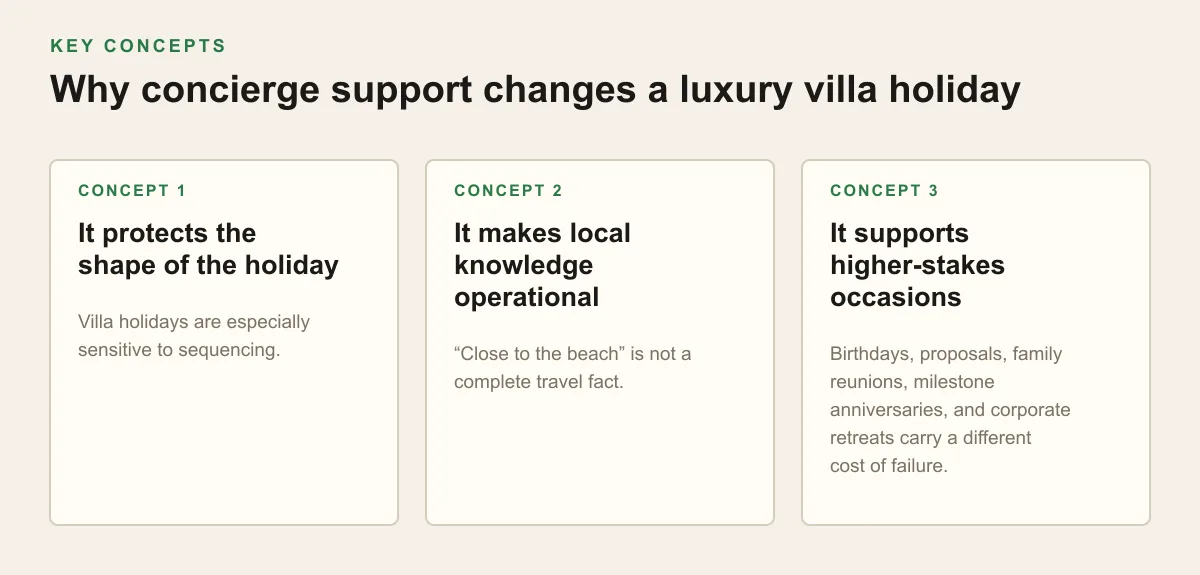
Why concierge support changes a luxury villa holiday
The main benefit is not extravagance. It is reduced uncertainty. Affluent travelers are often buying back time: time that would otherwise be spent comparing transfer options, chasing confirmations, explaining dietary requirements repeatedly, or diagnosing a pool issue from a distance.
It protects the shape of the holiday
Villa holidays are especially sensitive to sequencing. A group may land in Málaga, collect luggage, wait for a transfer, shop for provisions, check in, unpack, and then discover that the restaurant booking is across town at the same time the children need dinner. The itinerary has not failed because any one booking was impossible; it failed because the dependencies were never mapped.
A concierge should examine the day as a chain:
- When does the flight land, and how much flexibility is needed for luggage and children?
- Who is meeting the guests, and how will they identify the vehicle or access the community?
- Will groceries be delivered before or after check-in?
- Does a chef need the kitchen prepared, specialist equipment, or a particular arrival time?
- How long does the proposed drive actually take at the relevant time of day?
- What is the fallback if the weather changes or a supplier is unavailable?
This is why a concierge can be more valuable for a family or group than for a couple. More guests mean more dietary preferences, mobility considerations, bed configurations, activity interests, and opinions. The service is not simply adding options; it is reducing coordination load.
It makes local knowledge operational
“Close to the beach” is not a complete travel fact. A villa may be geographically near the coast but awkward for a large group without cars, or convenient for Puerto Banús but less suitable for a quiet family lunch. “A day trip to Málaga” also means different things depending on whether the priority is museums, shopping, a late lunch, or an easy day with a baby.
Official destination guidance can help establish the broad character of the Costa del Sol and its towns, but it does not replace a property-specific conversation about travel time, access, opening hours, or guest preferences. Spain’s official tourism site, for example, presents Costa del Sol as a destination combining beaches, towns, culture, gastronomy, and outdoor activities; the concierge’s job is to convert those broad possibilities into a feasible plan for a particular villa and party. Spain’s official Costa del Sol guide is a useful starting point for that wider destination context.
It supports higher-stakes occasions
Birthdays, proposals, family reunions, milestone anniversaries, and corporate retreats carry a different cost of failure. A basic restaurant booking may be recoverable. A missed airport transfer before a surprise event may not be.
For those stays, the concierge should create a written event brief covering:
- the purpose of the occasion and what must remain confidential;
- the guest list, dietary restrictions, accessibility needs, and preferred tone;
- arrival and departure windows for suppliers;
- the villa’s noise, parking, furniture, pool, and visitor limitations;
- the payment authority and cancellation terms;
- a wet-weather or late-arrival alternative.
That brief is a practical control, not unnecessary bureaucracy. It gives the villa team, chef, driver, florist, photographer, and host the same version of the plan.
How the concierge process works from enquiry to departure
Good service is visible in the handoffs. Guests should not have to repeat the same facts to the booking team, the driver, the chef, and the person meeting them at the villa. A useful process moves from broad intent to confirmed detail, then from active support to a clean departure.
1. The intake separates preferences from requirements
The first conversation should distinguish between non-negotiables and nice-to-haves. “We want a sea view” may be a preference. “One guest cannot manage stairs” is a requirement. “We would like a private chef” may still need clarification: one dinner, several dinners, children’s food, a tasting menu, or a cook who prepares meals in advance?
A concise intake should cover:
- party composition, ages, mobility, and sleeping arrangements;
- arrival airport, flight details, vehicle needs, and luggage volume;
- food allergies, religious or medical dietary requirements, and children’s routines;
- preferred pace: quiet, social, active, celebratory, or mixed;
- desired privacy level and willingness to have suppliers visit the property;
- activities, restaurant interests, beach preferences, and transport tolerance;
- budget authority, booking responsibility, and who receives confirmations.
For a family office or travel advisor, the last two points are important. The person paying may not be the person travelling, and the guest who can approve a change may be overseas. A concierge should know who can make which decision.
2. The villa is audited against the request
Before promising an experience, the provider should check the home. A chef may need a workable kitchen, a celebration may need suitable outdoor space, and a guest with limited mobility may need a bedroom and bathroom on the correct level. A villa with a spectacular terrace may still be unsuitable for an event if access, parking, or neighbour restrictions make supplier movement difficult.
The audit should address:
- access roads, gates, keys, parking, lifts, stairs, and arrival lighting;
- bedroom distribution, bathrooms, cot space, and privacy between groups;
- pool design, fencing or supervision requirements, and terrace hazards;
- kitchen equipment, refrigeration, serving areas, and cleaning arrangements;
- internet, workspace, sound systems, heating, air conditioning, and backup procedures;
- visitor rules, permitted supplier access, event limitations, and community requirements.
This stage prevents a common failure: selling an attractive service before checking whether the property can support it. Feasibility comes before enthusiasm.
3. The plan is sequenced, not merely listed
A list of bookings is not an itinerary. A sequence shows what happens first, what depends on it, and where recovery time exists. For example, a private chef should not arrive before the guests have access to the property and enough time to settle. A boat excursion should not be followed by a rigid dinner reservation if the group must travel back, shower, and dress.
The following is an illustrative planning example, not a universal benchmark:
- 15:00 arrival at the villa after airport transfer.
- 15:30 luggage settled, house orientation completed, and chilled provisions available.
- 17:00 flexible pool and terrace time, with no fixed external booking.
- 19:30 chef service begins, allowing for children to eat earlier if needed.
- 22:00 quiet close and confirmation of the next day’s transport.
The numbers show the principle: build slack between dependencies. A luxury itinerary should feel unhurried because the plan includes recovery space, not because the team hopes delays will not happen.
4. Arrival and in-stay communication are designed in advance
Guests need one clear arrival message containing the address format, meeting instructions, emergency contact, check-in expectations, and any immediate house rules. They should not receive five conflicting messages from separate suppliers.
During the stay, communication should follow an agreed channel and cadence. Some guests want a daily message with the next day’s arrangements. Others prefer complete privacy and will contact the concierge only when needed. A travel advisor may want operational updates while the principal guest receives only concise, polished information.
Personal data should be handled deliberately. The European Commission’s explanation of GDPR principles highlights requirements including purpose limitation, data minimisation, accuracy, storage limitation, and appropriate protection of personal data. Those principles are directly relevant when a concierge holds passport details, flight information, dietary requirements, children’s information, or access codes. The European Commission’s GDPR principles provide the appropriate baseline for deciding what information is genuinely needed and who should receive it.
5. Departure closes the loop
Departure is more than collecting keys. The concierge should confirm transport timing, luggage arrangements, rubbish or food procedures, damage reporting, forgotten items, and any outstanding supplier payments. For an owner or family office, the post-stay record can also identify maintenance issues before the next arrival.
A concise departure record might note:
- what the guest requested and whether it was completed;
- any property defect, missing item, or supplier incident;
- guest preferences worth retaining with permission;
- which charges remain open and who approved them;
- what should change before the next booking.
Where Villa Concierge service breaks down
Most disappointing experiences are caused by unclear boundaries rather than a lack of luxury. The guest hears “we can arrange anything”; the provider hears “we will make reasonable enquiries”. Those are different commitments.
Overpromising third-party availability
Chefs, drivers, boats, wellness practitioners, restaurants, and guides are independent supply points. A concierge can recommend, enquire, coordinate, and sometimes secure priority, but cannot honestly guarantee availability without confirmation. Peak dates, major events, weather, and short notice all reduce choice.
The correct language distinguishes:
- confirmed: the supplier has accepted the booking and the terms are recorded;
- held: the supplier has temporarily reserved a slot, subject to a deadline;
- requested: an enquiry has been sent but nothing is secured;
- recommended: the option fits the brief but the guest must decide whether to proceed.
This vocabulary is particularly valuable for advisors and family offices, where an itinerary may be circulated internally before every component is final.
Ignoring the property’s physical and legal limits
A villa cannot automatically become a venue. Parking, noise, visitor numbers, community rules, insurance, licensing, and local accommodation requirements may limit what can take place. Requirements can differ by municipality and activity, so a provider should verify the relevant conditions rather than assume that a private home can host any event or commercial service.
For regional context, Andalucía’s official tourism administration provides information about tourism policy and the sector’s regulatory framework. That is a better starting point for checking official requirements than relying on a supplier’s casual assurance. Andalucía’s official tourism information should be consulted when an arrangement involves regulated accommodation, commercial activity, or a larger gathering.
Weak emergency planning
A concierge is not a doctor, security officer, or emergency service. The role is to help guests reach the appropriate authority and then coordinate practical support around the incident. Arrival information should make this distinction clear.
In Spain, 112 is the single European emergency number for urgent assistance. The European Commission explains that 112 can be used to reach emergency services across the European Union. The European Commission’s 112 information is worth including in guest guidance, alongside the villa address, local access instructions, and the concierge contact.
A sensible escalation sequence is:
- Call the appropriate emergency service when there is immediate danger.
- Give the exact villa address, gate details, and access instructions.
- Notify the concierge or property contact once urgent help is on the way.
- Arrange translation, transport, pharmacy support, family communication, or property access as appropriate.
- Record the incident factually and protect the guest’s privacy.
Failing to plan for weather
Outdoor dining, boat days, golf, beach plans, and mountain excursions all carry weather exposure. A concierge should not wait until the morning of the activity to improvise. The plan should define a decision point, a source of weather information, the cancellation terms, and a credible alternative.
Spain’s national meteorological agency, AEMET, publishes official forecasts and warnings that can inform this process. AEMET’s official forecast service is more appropriate for weather-dependent planning than a vague assumption that the Costa del Sol will be sunny every day.
The alternative does not need to be a lesser experience. A rainy beach morning might become a long lunch, a private cooking session, a museum visit, or a wellness appointment at the villa. The key is to protect the day’s purpose even when the original activity changes.
How practitioners apply concierge support in Marbella and the Costa del Sol
The best approach varies by guest type. A couple celebrating an anniversary does not need the same operating model as a twelve-person family, and a travel advisor needs more documentation than a guest booking directly.
For families
Family service should prioritise predictability and recovery. Ask about nap schedules, car seats, pool confidence, food timing, grandparents’ mobility, and whether adults want occasional childcare enquiries or simply more flexible meal arrangements.
A useful family brief may include:
- child-friendly bedroom allocation and cot requirements;
- arrival provisions for the first evening and breakfast the next morning;
- car seats and transfer configuration confirmed before landing;
- one low-effort activity and one flexible day;
- pool supervision expectations explained without implying that supervision is provided;
- restaurant choices with early dining and space for children.
The trade-off is that more structure can reduce spontaneity. The answer is not to schedule every hour. It is to secure the fragile elements—transfers, special meals, childcare enquiries, and time-sensitive activities—while leaving ordinary villa time open.
For couples and small groups
For couples, concierge value often sits in discretion and atmosphere: a private transfer, a carefully timed dinner, a proposal setup, a photographer, a wellness treatment, or a day on the water. The service should be subtle. Too many messages and too much visible coordination can undermine the privacy guests chose a villa to obtain.
For travel advisors
Advisors need operational confidence. They should receive a clean pre-arrival summary, clear payment and cancellation information, supplier status, emergency contacts, and an escalation route. They also need to know which parts are directly managed and which depend on third parties.
Before confirming a booking, ask the concierge provider:
- Who owns the guest relationship before arrival and during the stay?
- How are dietary, accessibility, and privacy details documented?
- What is the response process when a supplier cancels?
- Which services are included, quoted separately, or subject to commission?
- How are guest data, access codes, and documents shared?
- What does the owner or advisor receive after an incident?
These questions expose the difference between a polished sales promise and a functioning service system.
For owners and family offices
Owners need the concierge to protect both guest satisfaction and the asset. A request that pleases one guest could damage the property, breach community rules, or create a maintenance problem for the next arrival. The provider should therefore maintain an approved supplier list, document exceptions, and escalate anything outside the agreed operating policy.
An illustrative starting policy—not a universal benchmark—could require written owner approval for:
- events involving more than 10 external visitors;
- new suppliers entering the property for the first time;
- temporary installations, amplified music, or unusual furniture movement;
- activities involving open flames, animals, specialist equipment, or water access;
- any request that may affect neighbours, insurance, licensing, or the building fabric.
The numbers above are deliberately illustrative. The correct threshold depends on the villa, community, insurance position, owner’s risk appetite, and local requirements. What matters is that the threshold exists and is known before an urgent request arrives.
Choosing a provider: a practical decision test
When comparing concierge options, do not begin with the longest service menu. Begin with the quality of the operating model. A shorter list with accountable coordination is often more useful than a catalogue of possibilities that guests must organise themselves.
| Question | What a strong answer should clarify |
|---|---|
| Who is the named contact? | Whether guests have one accountable person or must navigate several departments and suppliers. |
| How are requests confirmed? | Whether “requested”, “held”, and “confirmed” have distinct meanings. |
| How are villa limits checked? | Whether access, noise, parking, visitor, and equipment constraints are reviewed before promises are made. |
| What happens when plans fail? | Whether there is a documented escalation path and a realistic alternative. |
| How is information handled? | Whether only necessary guest data is collected and shared with appropriate parties. |
| What does the owner receive? | Whether incidents, maintenance observations, supplier issues, and guest preferences are recorded after departure. |
For guests who want a single point of contact for local arrangements, property orientation, and tailored experiences, Supervillas describes its luxury villa concierge services as part of the wider stay rather than as a disconnected booking add-on.
The specific recommendation for a successful villa stay
Use concierge support where coordination, timing, privacy, or consequence justify it. Do not outsource every small decision by default. Instead, identify the moments that can damage the holiday if they go wrong: airport arrival, access to the villa, the first evening’s food, mobility or dietary requirements, special occasions, weather-sensitive activities, and the response to a property issue.
Before arrival, request a written brief that states the villa’s limits, confirmed services, outstanding decisions, supplier cancellation terms, emergency route, and preferred communication channel. During the stay, keep the itinerary flexible around those fixed points. After departure, require a short record of incidents, preferences, and property follow-up.
That is the practical meaning of a villa concierge in Marbella: not unlimited luxury on demand, but accountable local coordination that respects the home, the guest, and the realities of the Costa del Sol. For a curated villa, personal planning, and local support in Marbella and surrounding destinations, explore what Supervillas Rentals offers at Supervillas Rentals.